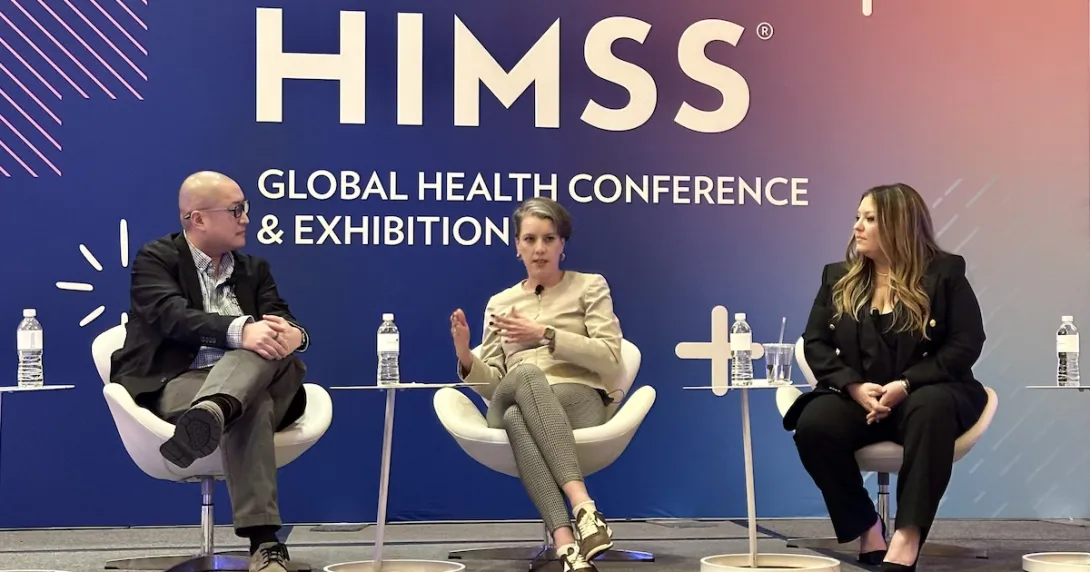
From left: Haipeng (Mark) Zhang, acting assistant under secretary for health (AUSH), discovery, education and affiliate networks (DEAN) at the U.S. Department of Veteran Affairs; Sarah Hatchett, SVP and CIO at Cleveland Clinic; and Rachel Coren, VP and associate CIO at Cedars-Sinai Health System
Photo courtesy of Nathan Eddy
LAS VEGAS – Healthcare organizations designing the next generation of hospitals are shifting their focus from hardware-heavy "smart building" concepts to more flexible, software-driven environments that support evolving clinical workflows, according to a panel during the 2026 HIMSS Global Health Conference & Exposition here Monday.
Five to 10 years ago, the idea of a smart hospital often centered on installing large amounts of specialized hardware and connected devices throughout a facility. Today, health system leaders say the real transformation is happening in software, data integration and AI-enabled workflows that operate quietly in the background.
"It’s a real shift in the industry," said Sarah Hatchett, senior vice president and chief information officer at Cleveland Clinic.
In the panel, moderated by Hatchett, Haipeng (Mark) Zhang, acting assistant under secretary for health (AUSH), discovery, education and affiliate networks (DEAN) at the U.S. Department of Veteran Affairs; and Rachel Coren, vice president and associate chief information officer at Cedars-Sinai Health System, explained the goal is to create environments where digital tools support care delivery without dominating it.
"How do you create a space and ecosystem that supports the flex that meets the pace of emerging tech?" Hatchett asked.
Health systems are increasingly designing hospitals with adaptability in mind, recognizing that clinical workflows and digital tools may evolve significantly over the life of a facility.
Coren said planning for a new hospital can begin five to seven years before the building opens, which makes anticipating technology needs particularly challenging.
"You're designing a space years before many of the systems will even exist," Coren said.
That reality has pushed organizations to focus on infrastructure and flexibility rather than betting on specific technologies.
"Start with your infrastructure," she said. "Define how much capacity you want to leave free on day one."
Cedars-Sinai is applying that philosophy to a new smart hospital opening later this year, built around the idea of digitally connecting people, systems and equipment while using real-time data to guide clinical decisions.
One major bet involves better data visualization and analytics capabilities that allow clinicians to synthesize information from multiple sources.
At the same time, both experts emphasize that technology should support – not overwhelm – the human experience of care.
Coren described the goal as "digital-first, but not digital-only," noting that patients still interact with healthcare in different ways.
The design process also includes extensive collaboration with operational leaders and clinicians to ensure new technologies improve care delivery.
"Start with the operations folks and ask what their goals are and what technology could enhance," she said.
Some of the most promising advances involve AI-powered tools that reduce administrative burden for clinicians.
Ambient documentation systems that automatically generate clinical notes from conversations have already begun improving workflows in some environments.
"Our nurses and aides have a tremendous administrative burden," Coren said. "When you can give things to your clinicians that give them more time with their patients, that's a big win."
Hatchett said the broader goal is to move beyond traditional episodic models of care and design hospitals that function as active participants in the care process.
"In this scenario, the building becomes part of the care team and the care process," said Hatchett.
At the same time, she cautioned that technology decisions must remain tied to real operational challenges rather than novelty.
"What's the business problem we're trying to solve?" Hatchett said. "It’s not about putting shiny new tech in every patient room."
Ultimately, the panelists said the success of smart hospital design will depend on creating environments that adapt to changing technology while improving both clinician and patient experiences.
"At the end of the day it's about returning time back to the physicians," Hatchett said.